
Table of Contents
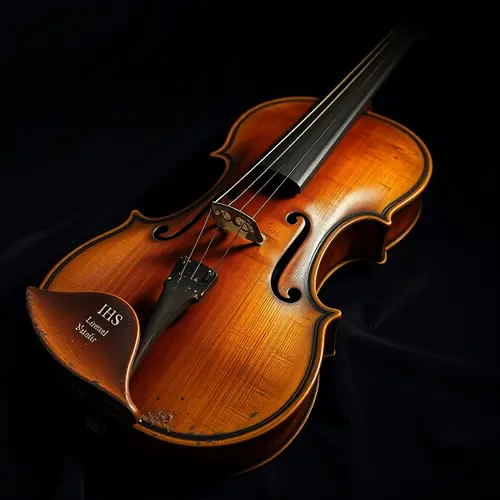
Giuseppe Guarneri, known as Guarneri del Gesù, stands among history’s most revered violin makers. His instruments produce a darker, more powerful tone than his contemporary Stradivari’s creations, making them prized by soloists who demand projection and emotional depth. Born in Cremona, Italy, this master luthier crafted violins that would eventually command millions at auction and shape the sound of classical music performance.
The Life and Workshop of Giuseppe Guarneri
Giuseppe Guarneri worked in Cremona from approximately 1731 until his death in 1744. Unlike the prolific Stradivari workshop, Guarneri operated a smaller operation, producing roughly 200 instruments during his career. This limited output makes authentic Guarneri violins exceptionally rare.
His instruments bear the label “IHS” (a Christogram) along with his name, earning him the designation “del Gesù.” The Metropolitan Museum of Art notes that his construction methods departed from strict Cremonese traditions, showing more individualistic approaches to arching, edge work, and varnish application.
Craftsmanship Techniques That Defined Giuseppe Guarneri
Guarneri’s violins feature distinctive characteristics that experts recognize immediately. The archings tend toward flatter profiles compared to Stradivari models. His f-holes often appear longer and more angular. The edges show less precision, with tool marks occasionally visible, suggesting rapid, confident work rather than obsessive refinement.
The varnish applied by giuseppe guarneri ranges from golden-brown to deep red-brown hues. Chemical analysis conducted by the Smithsonian Institution reveals oil-based formulations with pine resin components, though the exact recipe remains debated among researchers.
Sound Characteristics and Performance Value
Professional violinists describe Guarneri instruments as possessing a “darker” and “more complex” tonal palette. The sound projects with remarkable power, cutting through orchestral textures without harshness. This quality makes giuseppe guarneri violins particularly valued for concerto performance.
| Characteristic | Giuseppe Guarneri | Antonio Stradivari |
|---|---|---|
| Tonal Quality | Dark, powerful, complex overtones | Brilliant, clear, focused |
| Projection | Exceptional power and depth | Even clarity across registers |
| Edge Work | Bolder, less refined | Precise, delicate |
| Arching | Flatter profiles | Higher, more rounded |
| Approximate Survival | 130-150 instruments | 650+ instruments |
Famous Instruments and Their Stories
The “Cannon” Guarneri, played by Niccolò Paganini, represents perhaps the most celebrated example. Paganini bequeathed this instrument to the city of Genoa, where it remains under the condition that no one else play it. The violin’s explosive sound capabilities contributed to Paganini’s legendary technical reputation.
Violinist Jascha Heifetz performed on a 1742 giuseppe guarneri for most of his career. The San Francisco Symphony’s archives document how Heifetz specifically chose Guarneri over available Stradivari options for the instrument’s penetrating tone quality.
Authentication and Market Value
Authenticating a giuseppe guarneri violin requires expertise from established experts like J&A Beare in London or Jacques Français Rare Violins in New York. Authentication examines wood grain patterns, construction methods, varnish composition, wear patterns, and label authenticity.
Auction records show giuseppe guarneri instruments selling between $4 million and $18 million, depending on condition and provenance. The limited supply creates intense competition among collectors and performing artists. Investment funds specifically target these instruments as alternative assets with historically stable appreciation.
Common Misconceptions About Guarneri Violins
Many assume all old Italian violins sound superior to modern instruments. Blind listening tests published in the Proceedings of the National Academy of Sciences revealed professional musicians often cannot distinguish between fine modern violins and historic Italian instruments in performance settings. The reputation of giuseppe guarneri rests on measurable acoustic properties, not mystique alone.
Another myth suggests Guarneri’s “secret” involved special wood treatments. Dendrochronology studies indicate he used standard Alpine spruce and Balkan maple. The acoustic superiority stems from design choices—arching geometry, graduation thickness, and bass bar placement—rather than supernatural wood properties.
Technical Analysis of Construction Methods
Detailed measurements of giuseppe guarneri violins reveal systematic patterns in his work. The upper bout widths average 167mm, with back lengths typically 356mm. Rib heights measure approximately 30mm, slightly taller than standard Stradivari models.
CT scanning performed by institutions like the Violin Museum in Cremona shows Guarneri’s graduation patterns favor thicker central areas with rapid thinning toward edges. This mass distribution affects vibration modes, enhancing fundamental frequencies while adding complex overtones.
- Thicker soundpost areas provide stability for string tension
- Asymmetric f-hole placement optimizes air resonance
- Flatter arching reduces high-frequency damping
- Lower rib height affects corpus resonance frequency
- Edge channel depth influences flexibility response
Preservation and Restoration Considerations
Maintaining a giuseppe guarneri instrument requires specialized knowledge. Original components like the neck, fingerboard, and bridge have typically been replaced to accommodate modern playing standards. The gut strings Guarneri knew have given way to steel or synthetic cores, changing tension dynamics significantly.
Conservators prioritize preserving original wood and varnish. The International Violin Restoration Institute emphasizes non-invasive techniques that maintain historical integrity while ensuring playability. Over-aggressive restoration can diminish both acoustic quality and collector value.
Expert Opinion on Sound Production
The acoustic advantage of giuseppe guarneri violins emerges from cumulative design choices rather than single factors. The combination of arching geometry, plate graduation, and bass bar positioning creates specific resonance patterns. Modern makers can replicate individual features, but capturing the complete acoustic signature requires understanding how these elements interact dynamically.
Physical modeling suggests the flatter arching reduces stiffness in plate modes above 2kHz, allowing more complex spectral content. This technical explanation accounts for the subjective impression of “darkness” musicians describe. The sound contains more energy in lower partials relative to the fundamental, enriching tonal complexity.
Legacy in Performance Practice
Contemporary soloists continue choosing giuseppe guarneri violins for demanding repertoire. The Chicago Symphony Orchestra’s former concertmaster used a 1735 Guarneri specifically for Romantic concertos requiring maximum projection. Chamber musicians sometimes prefer Stradivari models for blend, but concerto soloists consistently favor Guarneri’s power.
This preference reflects practical acoustic requirements. Concert halls have grown larger, and orchestras have expanded. The penetrating quality that giuseppe guarneri built into his instruments addresses performance demands that did not exist in the Baroque era. His violins accidentally anticipated modern concert conditions.
The enduring significance of giuseppe guarneri violins lies in their successful marriage of physical craftsmanship with acoustic science. These instruments represent not just historical artifacts but functional tools that continue shaping musical interpretation. Understanding his methods provides insight into the intersection of artisanship, materials science, and artistic expression.
Related reading: learn musical instrument: 5 Essential Tips for Beginners and 7 Essential Skills Every Professional Orchestra Players Need.

Kurnia Ardha is a senior education strategist at Pralearn covering learning science, admissions, testing, and financial planning. 6+ years, 140+ guides. Method: cognitive research, admissions data, and aid policy modeling. Author of 2,084 education guides since 2022.


More Stories
learn musical instrument: 5 Essential Tips for Beginners
Easiest Instrument to Learn: 7 Top Picks
7 Essential Traditional Skills Worth Mastering