
Table of Contents
If you’re searching for how to improve your piano skills, you’re likely asking a bigger question: what actually makes a pianist sound great? It’s not one magical trick. True proficiency is built on a handful of foundational mechanical and mental abilities working together. Master these, and everything else—from Bach to Billy Joel—becomes accessible.
This breakdown moves beyond vague advice. We’ll define the concrete, trainable components that separate struggling students from confident musicians.
The Technical Piano Skills: What Your Hands Need to Learn
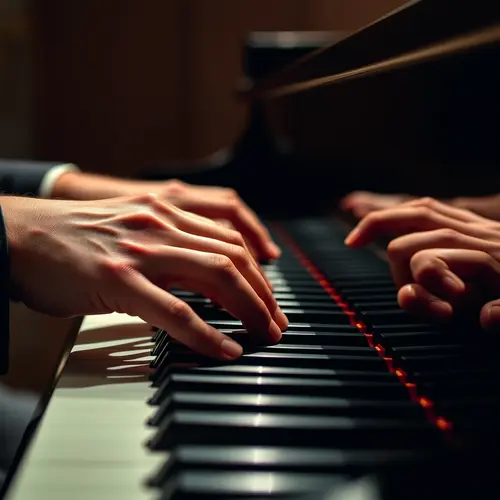
Before expression comes execution. The physical mechanics of playing are non-negotiable. Think of this as the athlete’s training regimen for your fingers, hands, and arms.
1. Finger Independence and Dexterity
This is the bedrock. It’s the ability to move each finger with precise control, strength, and speed, independently of the others. A common bottleneck for beginners is the fourth and fifth fingers, which are naturally weaker.
Expert pianists develop this through targeted exercises. Scales and arpeggios aren’t just warm-ups; they are diagnostic tools. A stumble in a B-flat minor scale reveals a coordination gap that needs direct attention.
- Practice Focus: Hanon and Czerny exercises, practiced slowly with a metronome, focusing on even tone and rhythm.
- Common Myth: “Fast playing is the goal.” Speed is a byproduct of control. Prioritize perfect, slow repetition over messy, fast attempts.
2. Dynamic Control and Touch
Hitting the right note is just step one. How you hit it—the velocity, weight, and angle of your finger’s descent—determines the music’s emotion. This is where the piano becomes a truly expressive voice.
Dynamic control means seamlessly moving from a whisper-soft pianissimo to a powerful fortissimo. It also involves voicing: making one note in a chord sing out louder than the others to create melody within harmony.
- Practice Focus: Play scales with a deliberate crescendo up and decrescendo down. Practice chords, deliberately bringing out the top note, then the bottom note.
- Expert Insight: The sound is made before the key is struck. Your mental intention for the volume and character directly dictates your physical approach.
The Cognitive Piano Skills: Training Your Musical Mind
Outstanding piano skills live as much in your mind as in your hands. Cognitive mastery is what allows you to play without constant score-staring or paralyzing fear of mistakes.
Sight-Reading: Your Real-Time Piano Skills
Sight-reading is the ability to play unfamiliar music at first sight. It’s a complex real-time processing task: decoding symbols, mapping them to keys, and anticipating rhythm all at once.
According to a pedagogical review in the Journal of Music Teacher Education, systematic daily sight-reading practice is the single most reliable predictor of overall musical fluency. It forces the brain to integrate all fundamental skills under time pressure.
- Practice Focus: Dedicate 5-10 minutes daily to completely new, simple material. Keep your eyes on the page and your hands moving, prioritizing continuity over perfection.
Ear Training and Theory Integration
This is the feedback loop that turns a mechanical player into a musician. Ear training allows you to hear a melody and replicate it, or identify a chord progression. Music theory provides the “why”—the rules of harmony and structure.
Together, they enable you to memorize music faster, improvise, and recover from mistakes mid-performance because you understand the musical context, not just the finger sequence.
| Skill Area | Beginner Focus (Months 1-12) | Intermediate Focus (Years 1-3) | Advanced Application |
|---|---|---|---|
| Finger Dexterity | Basic 5-finger patterns, simple scales | All major/minor scales, arpeggios at tempo | Complex passagework in repertoire |
| Dynamic Control | Differentiating loud (f) vs. soft (p) | Graded dynamics within a phrase, basic voicing | Nuanced tonal coloring, projection in large halls |
| Sight-Reading | Single-line melodies in C position | Simple two-hand coordination, key changes | Reducing prep time for new repertoire |
| Ear & Theory | Matching pitch, identifying intervals | Identifying chord qualities, simple transcription | Analysis of form, stylistic improvisation |
Piano Skills Paradox: Why More Time Isn’t Always the Answer
Simply logging hours on the bench is inefficient. Deliberate practice—focused, goal-oriented, and reflective—is what forges neural pathways. A study on expert performance, often cited by institutions like the National Association for Music Education, emphasizes targeted error correction over mindless repetition.
Here’s a hypothetical troubleshooting scenario: A student can play a difficult run fast but messes it up 30% of the time. The common approach is to play it fast over and over, hoping the mistakes disappear.
The expert approach is diagnostic. Is the stumble always under the fourth finger? Is the thumb turn clumsy? Isolate the two-note transition that fails. Practice that micro-movement alone, perfectly, ten times. Then re-embed it into the phrase. This addresses the root cause, not the symptom.
Building Your Piano Skills – Holistic Regimen
Integrating these elements into a daily routine is key. Your practice session should be a balanced workout, not a random walk.
- Technical Work (20%): Scales, arpeggios, exercises. Focus on quality of movement.
- New Material / Sight-Reading (25%): Apply your technique to fresh challenges.
- Active Repertoire Work (45%): Polishing pieces, using deliberate practice methods.
- Ear & Theory (10%): A short dedicated drill, like interval identification or analyzing a piece’s chord progression.
Progress in piano skills is cumulative and interdependent. Weak sight-reading slows down learning new pieces. Poor finger independence limits dynamic expression. By understanding and training these core areas systematically, you build a resilient, adaptable skill set. The goal isn’t to learn pieces; it’s to build the machinery that lets you learn any piece with clarity and confidence. That is the definitive mark of mastered piano skills.

Kurnia Ardha is a senior education strategist at Pralearn covering learning science, admissions, testing, and financial planning. 6+ years, 140+ guides. Method: cognitive research, admissions data, and aid policy modeling. Author of 2,084 education guides since 2022.

More Stories
Mastering Advanced Skills: 5 Frameworks for Career Growth
learn musical instrument: 5 Essential Tips for Beginners
Giuseppe Guarneri: Master Violin Maker’s Timeless Legacy